Decades after the term’s first use, the trope of the “welfare queen” has seen an aggressive re-emergence in political conversation. A term popularized by Ronald Reagan and the Republican Party in the late 1970s, the welfare queen stereotype has never quite dropped from the minds of Americans. Claims of widespread abuse and fraud in federal benefit payments have existed as long as the welfare system has, but it wasn’t until after the civil rights movement that this behavior was pinned exclusively on Black women.
In 1976, as Reagan took to the campaign trail, he alluded to the story of Linda Taylor, a woman accused of scamming the government out of thousands of dollars in welfare checks by using a variety of false identities. Naturally, her story was sensationalized by the media, with the Chicago Tribune first bestowing the label of “welfare queen” upon her. Taylor embodied the perfect cliché of someone who might abuse the welfare system: She drove an expensive car, wore furs, had multiple children from different relationships, and was a Black woman. Newspapers around the country cherry-picked and reinforced Reagan’s attempts to spread misinformation about the details of Taylor’s story, allowing for the stereotype to take hold in the thoughts of policymakers and voters alike.
From then onward, Black women, typically those who were single mothers, were scapegoated and misconstrued by those who wanted to implement welfare reforms. Law-abiding people who merely hoped to receive what the system legally provided were portrayed as Linda Taylors and put under the microscope.
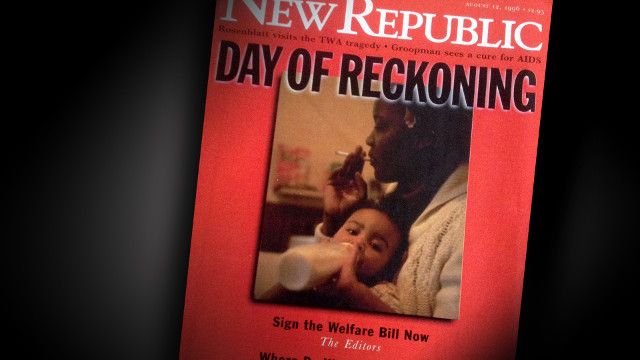
Under Bill Clinton’s presidency, the welfare queen again appeared in the efforts to reshape the welfare system, as Congress passed new legislation that made it much more difficult to receive government assistance. Although it was spread first by Republicans, pointing to the so-called issue of welfare queens became a bipartisan strategy, uniting the two parties around a racist, classist trope. The New Republic, then seen as a center-left magazine, ran a notorious cover photo that featured a Black woman smoking a cigarette while caring for her child, with the caption “Day of Reckoning: Sign the Welfare Bill Now.”
Black women, typically those who were single mothers, were scapegoated and misconstrued by those who wanted to implement welfare reforms.
During the government shutdown that ended on Wednesday, the Supplemental Nutrition Assistance Program (SNAP), one of the major benefit programs for the poor that remains, was put in jeopardy. On November 1, federal funding for the 42 million people who rely on SNAP benefits officially “ran out.” This was triggered by the U.S. Department of Agriculture’s (USDA) decision to withhold November allocations for SNAP, despite the ability to tap into a $5 billion contingency fund. This decision was juxtaposed with the Trump administration continuing to pay military expenses and funding a separate nutrition assistance program for women, infants, and children (known as WIC).
Pressured by two rulings by judges who said that the federal government must use the contingency fund for SNAP, the Trump administration first said that recipients would get up to 65 percent of their normal benefits. Following an immediate appeal by the Department of Justice, the Supreme Court eventually ruled that the Trump administration could continue to withhold SNAP benefits while Congress worked to pass a deal to end the shutdown. Some states quickly moved forward to fund full or partial benefits for SNAP recipients using their own funds, but then were told to “undo” those efforts. All in all, the past few weeks have been shrouded by deep confusion and chaos, which has impacted millions of SNAP participants.
One constant throughout the uncertainty has been the welfare queen trope, which has appeared on social media, in the statements of politicians, and in the mainstream news cycle. The stereotype was employed to rationalize the pause in SNAP benefits, and it proved effective. It’s almost like a virus, says Ange-Marie Hancock, professor of political science and gender studies at The Ohio State University. “Part of how stereotypes are positioned in our brain is that they are kind of chronically accessible. And so once they are learned, they are very difficult to completely eradicate.”
In other words, although the fact that the welfare queen stereotype has been debunked, and in many cases, discredited, its position in the minds of many Americans remains the same. “So even if it goes dormant … it is actually there for the taking or for the queuing again,” says Hancock. Now, Republicans are doing the work to retrigger the epidemic that is believing in the prevalence of widespread abuse of the welfare system by marginalized women, encouraging anti-welfare sentiment among voters.
On a segment of Newsmax, anchor Rob Schmitt baselessly claimed that “people are selling their benefits, people are using them to get their nails done, to get their weaves and their hair. This is a really ugly program.” This is false. SNAP recipients face strict restrictions on what they can and cannot purchase with their allocated funds, and cosmetic products fall into the latter category. Data shows that the average SNAP household receives a monthly benefit of $332, and those with children obtain $574, acting as additional support, not complete coverage for groceries, let alone hair care.
Schmitt’s assessment didn’t have to specifically mention Black women—it was abundantly clear who he was referring to. Sen. Ron Johnson (R-WI), who was in conversation with Schmitt, did not attempt to refute that statement.
It’s part of a blame game that Republicans are playing, and it fits into the rationale behind changes to SNAP made in the One Big Beautiful Bill Act (OBBBA). Starting in July, the eligibility requirements for SNAP recipients were tightened significantly, which will lead to 22.3 million families losing some or all of their food assistance over the next ten years. This provision in OBBBA was framed as a way to ensure that more Americans take on more personal fiscal responsibility (like with stricter work requirements), and so the program could be less susceptible to fraud.
The welfare queen stereotype was employed to rationalize the pause in SNAP benefits, and it proved effective.
Cuts to SNAP were one of the revenue offsets to the massive tax cuts for the nation’s most wealthy citizens in OBBBA, under the guise of blaming marginalized Americans for abusing the system. In this case, it’s been Black women, and also undocumented immigrants.
“When we have this narrative about welfare as wasteful, we have removed a narrative of a social safety net,” says Anna Branch, a professor of sociology at Rutgers University. “The function of Black women in these spaces is to kind of legitimize the kind of erasure and downfall of programs.” Advances in technology have made it much easier for this narrative to be empowered, and the tropes have been running rampant on the internet.
In what appears to be an impromptu street interview, a Black woman openly admits to selling her allocated food stamps. “I’ma keep it real with you, I get over $2,500 a month in stamps. I sell them, $2,000 worth for about 12 to 15 hundred cash. That’s why everybody’s upset. Folks say we’re taking advantage, but that’s how we get by.” Another clip shows a Black woman yelling at a grocery store employee who has told her that her food stamps have been declined. In yet another, two women are seen telling a cashier that because their EBT cards won’t swipe, they’ll just leave without paying.
But these videos aren’t real. They are all completely AI-generated, courtesy of OpenAI’s Sora 2. Other videos just like these have been landing on the timelines of thousands of people, many of whom are unable to tell that the content isn’t real. Comment sections are saturated with users spewing racist, sexist, and classist rhetoric, because such videos simply affirm their pre-existing beliefs. “People didn’t need videos,” says Branch. “They believed it on word, on sight, because it tapped into their broader belief about the sub-humanity, the depravation of Black people.”
These clips reinforce the misbelief that Black people account for the majority of SNAP benefits, and that they are more likely to engage in abuse of the system. But in actuality, non-Hispanic white people accounted for 44.6 percent of adult SNAP recipients in 2023, while 27 percent of both adult and child recipients were Black. Albeit less than Black people, white recipients have also seen a surge of stereotyping that is not entirely dissimilar to that of the welfare queen.
Instead of letting the trope die out due to statistical inaccuracy, it instead bloomed across racial lines. “The stereotype has now been applied to working-class white people as well,” says Hancock. All of the negative characteristics of the welfare queen—laziness, having more children than one can afford, and having substance use disorders—have been transferred onto white people. “Instead of the stereotype kind of being debunked by the facts or by the numbers, it’s kind of gone in the opposite direction,” Hancock added.
Additionally, there is no concrete evidence that Black people or undocumented immigrants are more likely to receive improper benefits, or sell them.
These truths have not been taken into consideration by outlets like Fox News, which took such AI-generated videos and marketed them as real. When faced with the fact of its insincerity, Fox News did not apologize, but rather rewrote the headline, and later deleted the article. (An archived copy is available here.)
Republicans resisted Democrats’ proposed shutdown deal by claiming that other aid programs, like ones that provide health insurance premium support, are being illegally accessed en masse by undocumented immigrants. Some groups of authorized immigrants (like refugees, children, and people with green cards) have been permitted by law since 1996 to access benefits, but under OBBBA, many communities will lose this support. Therefore, undocumented immigrants have similarly experienced the same stereotypes that have been assigned to Black Americans for decades, again pointing to the evolution of placing blame for supposed abuse of the system. It has added another layer to the constant targeting of undocumented immigrants at the hands of the federal government.
Now that the government shutdown has ended, SNAP recipients will begin to receive their benefits again. But this cannot undo the damage done. Losing a month of assistance has hit millions of households hard, and has breathed life into the welfare queen trope yet again. What the circulation of this stereotype neglects is that people from all races and backgrounds have participated and will continue to participate in programs such as SNAP and Medicaid. Everyone will face the consequences of these new policy changes.
“It’s broader than Black women,” says Branch. “It’s unfortunate that Black women are canaries in the coal mine of the American economy,” Branch contended. “The question is, do we care that no one can breathe?”