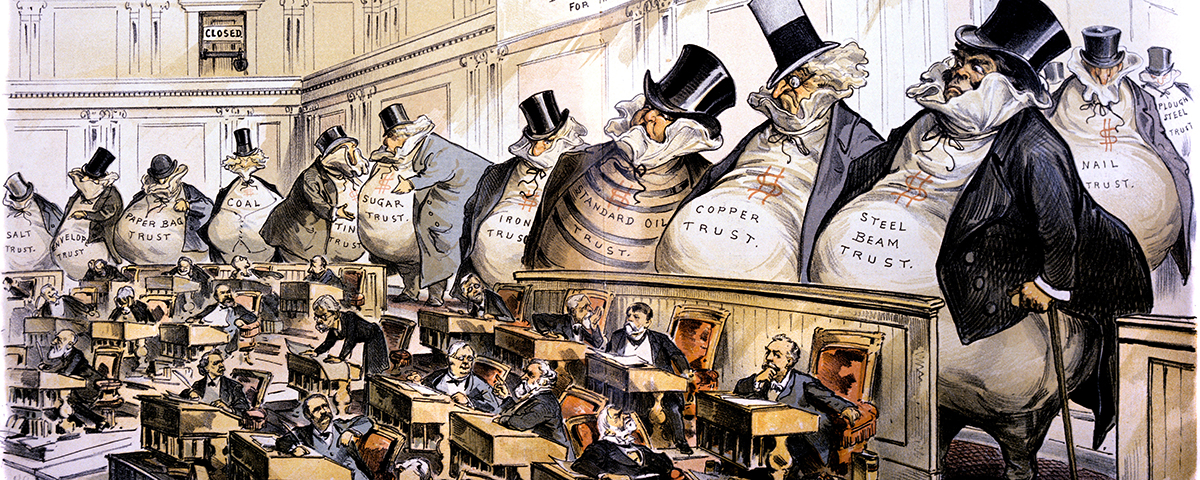
The political cartoons of the 1880s showed morbidly obese men representing the era’s trusts, their suits and top hats covering undergarments fashioned as a sack of money, perched ominously above policymakers, with the puppet strings implicit. That emblematic depiction of the first Gilded Age was burned into the public consciousness, and public outrage led to the Progressive Era reforms. The grifters of the time strained to keep themselves in power by attempting to make elections irrelevant and paying off whatever obstacle emerged in their path. Reform ultimately won out, but it took decades of hard work.
The present day has been called a Second Gilded Age so many times that it’s almost a cliché. But in Donald Trump’s second term, we are seeing history repeat in such vivid detail that I’ve actually grown large muttonchops just thinking about it.
The most prominent villains of the first Gilded Age were railroad barons like Jay Gould, who famously said some approximation of “I can hire one half of the working class to kill the other half.” But though he owned numerous railroads over his career, he never realized his goal of a single transcontinental railroad dominating shipping from coast to coast. His dream was coming into place until the Panic of 1907 created enough financial stress to scuttle a proposed merger between Gould’s system and the bounty of E.H. Harriman, who controlled the Union Pacific, Southern Pacific, and B&O railroads.
But this week, Union Pacific, one of Harriman’s old lines, announced its intent to merge with Norfolk Southern for $85 billion. Jay Gould would be proud. Forty-three states are touched by this proposed national railroad, which accounted for 43 percent of total rail shipping last year. The combination upends the gentlemen’s agreement whereby two eastern and two western railroads split up the U.S. in their respective regions. (The other two of the Big Four, Warren Buffett’s BNSF and CSX, have been rumored to merge too.)
Though railroads do not dominate American life as they did in the 1800s, freight rail remains a critical node of the supply chain, and critics argue that “precision scheduled railroading,” a Wall Street–fueled cost-cutting initiative, has made rail more extractive of its customers, more exploitative of its workers, and less safe. Critics have joked that PSR is neither precision, nor scheduled (as cutting maintenance and staff leads to an epidemic of delays), nor in many cases railroading—Norfolk Southern owned the train that derailed in East Palestine, Ohio, sending toxic plumage into the air.
The rail industry’s regulator, the Surface Transportation Board, will review the merger. But in this second Gilded Age, there’s little question that the companies will turn to lobbyists that have transformed briefly aggressive antitrust enforcement into a pay-to-play scheme.
We keep learning more about the Justice Department’s corrupt maneuvering on antitrust. Conservative journalist Sohrab Ahmari advanced the story on Wednesday, revealing “boozy backroom meetings” in “private city clubs” in Washington, where lobbyists close to the White House (in particular Mike Davis and Arthur Schwartz) persuaded Attorney General Pam Bondi and top DOJ officials to overrule the Antitrust Division and impose a weak settlement on a $14 billion merger between Hewlett Packard Enterprise and Juniper Networks. The department fired dissenters in the Antitrust Division soon after.
In this second Gilded Age, there’s little question that lobbyists have transformed briefly aggressive antitrust enforcement into a pay-to-play scheme.
Plying government officials with liquor in closed-door clubs to win favorable policy has a Gilded Age stench. Bill Rinner, one of the two Antitrust Division deputies who was fired, literally said in a speech in June, “We do not plan to hash out merger settlements over martinis.” Maybe the cocktail was different, but practically this is exactly what happened. Davis telling conservatives to “STFU” about Bondi was a warning shot to keep his side muted about the sorry display.
Things got even sleazier when someone got Axios’s Mike Allen to regurgitate spin that U.S. intelligence convinced Bondi’s team that the merger had to pass because of national security. Yet a large chunk of HPE’s business is domestic, providing wireless networks for businesses and colleges (and Juniper, the business HPE is buying, earns the majority of its revenue domestically); HPE raised no national-security concerns in any filings in the merger case; the Justice Department heard from nobody in the intelligence agencies when they first checked before filing the case; and HPE listed no contacts with intelligence officials on its disclosure forms, meaning that the intelligence community would have to have figured out on its own the details of this deal.
As I reported Tuesday, Democratic senators have asked the presiding judge to trigger a law called the Tunney Act, imposed during a different Gilded Age—the Nixon era—to deal with corruption in antitrust cases. This would allow the judge in the HPE-Juniper case to hold hearings and obtain documents that would reveal the schemes. But DOJ is adjusting to avoid this accountability in other cases. It’s clear that MAGA influencers want to set up a get-out-of-antitrust-jail shop for corporate America ($1 million minimum, no questions asked) and steamroll anyone in government who doesn’t like it. The word you’re looking for is graft.
And if all of this angers the voting public, and has them thinking of throwing the bums out, the bums will simply choose their voters to avoid a reckoning. On Wednesday, Texas released new maps designed to win as many as five seats in the House of Representatives. The maps would crack and pack Austin, Dallas, and Houston, and shuffle Latino-heavy South Texas to threaten two Democratic House members there.
Though the redrawing heightened concerns of a “dummymander,” whereby Texas Republicans would actually risk incumbent seats more than win new ones, experts saw the maps as largely successful. Thirty of Texas’s 38 seats on the new map saw Trump win by more than ten points in 2024, and though the swing is likely to be pronounced next year, that Republican advantage could hold. It is the case that Republicans would have lost several of these seats if these were the district lines in 2018, but that was eight years ago and Latino voters have since swung to the GOP, though it’s unclear whether they will swing back.
In response, blue states have rightly vowed to fight back, though previous commitments to independent redistricting and (unbelievably) a desire to maintain the moral high ground hamper their options. California and New York will struggle to try to put new maps in place for next year. Legal measures to get maps thrown out for racial discrimination have maybe a greater chance, though a slim one.
Eventually, the tit for tat among the states will resemble the pre-reform British standard of “rotten boroughs” drawn to keep members of Parliament in power (one constituency had just 11 voters, none of them residents), where control of Congress is driven mostly by cartography, and the will of the people is sidelined.
These are not the only Gilded Age flashbacks we’re seeing. Tariff rates are approaching the levels before the U.S. approved an income tax—and the income tax is being gradually ground down by rollbacks for the wealthy and weakened enforcement. Crypto deregulation is setting up wildcat banking and parallel currencies that in the hands of Walmart or Amazon could look like company-town scrip. If reforms manage to pass through the gauntlet of graft, Lochner-like courts invalidate them on behalf of big business, like the recent ruling blocking an Arkansas law banning pharmacy benefit managers from selling their own prescription drugs.
It’s hard to be very optimistic amid this orgy of corruption and bending of our political system to the benefit of a few. But the very fact of calling it a Second Gilded Age reinforces that we’ve been here before. And though it was even harder to communicate then and the forces arrayed against ordinary people were even more powerful, movements began to demand changes to the status quo that succeeded in reining in monopolies, building equitable contributions for the common good, and expanding voting rights. The work is long and difficult, but it can be done, and a public that disapproves of the status quo is begging for it.
The First Gilded Age ended. The second one must as well.